
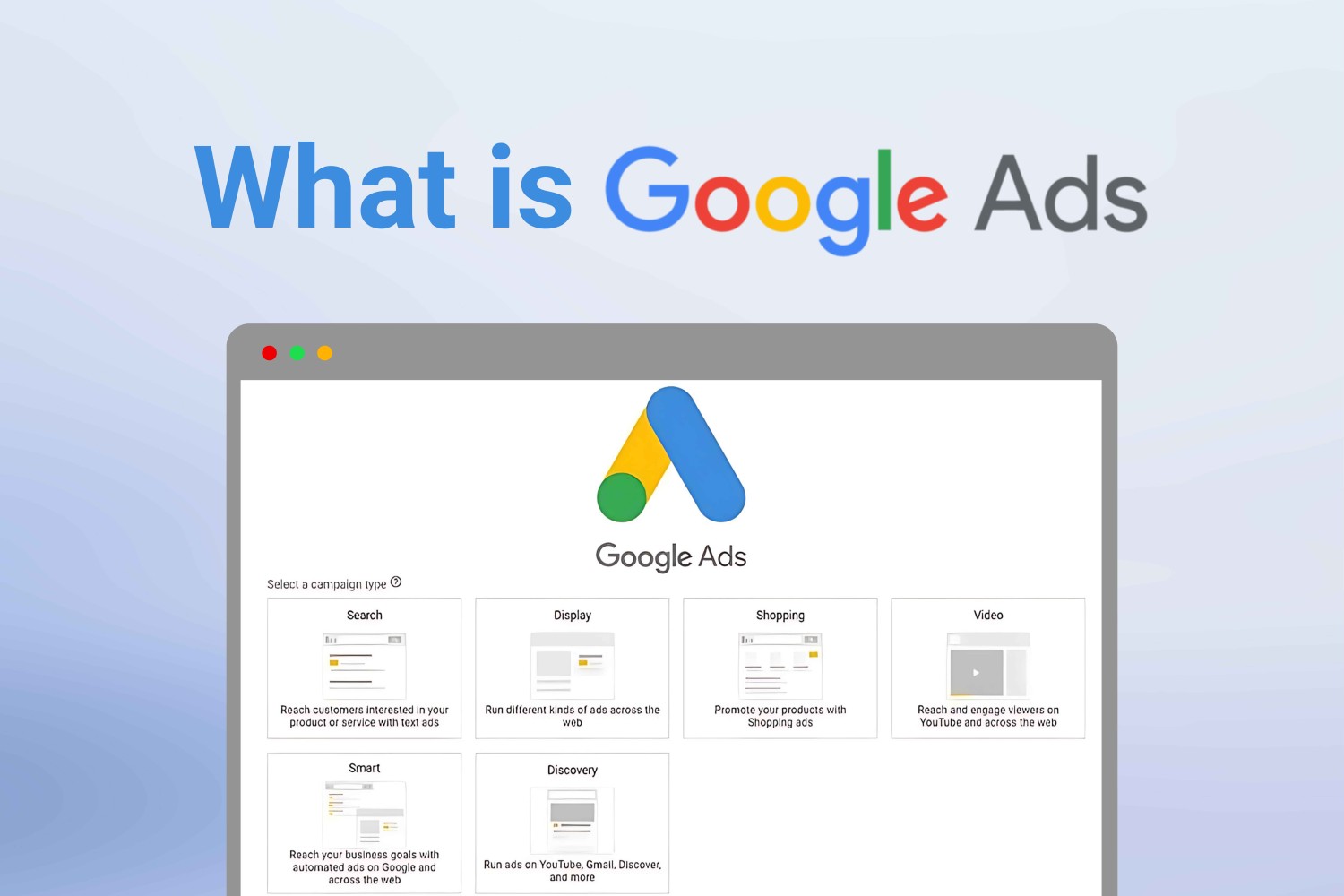
What is Google Ads? A Beginner’s Guide to 25 – 2026
It’s dominating the revolutionary world wide web ad landscape where Google Ads is a colossus that brings together small firms and mighty corporations and their consumers together with unflinching accuracy. Formerly known as Google AdWords, this world wide web advertisement behemoth enables advertisers to place web browsers in touch with short ads, business transactions, product information, and videos at the very moment when they search for the same commodity.
What is Google Ads? Google Ads is an online advertising platform by Google that helps businesses promote products and services through search, display, and video ads using a pay-per-click (PPC) model.
For every business ready to drive leads, sell, or gain brand seen-ness of 2025, Google Ads awareness and use is not a choice, but a fact. Google Ads will be used interchangeably in the course of the following book, and a step-by-step guide given to design and optimize effective campaigns.
Core Concept: How Google Ads Works requires
Google Ads is actually a pay-per-click (PPC) auction-style. When someone searches on Google Search, Google conducts an auction among those advertisers who’ve been bidding on keywords that match what’s being searched for. It’s not a straightforward auction where the person who bids the most wins. Google’s auction isn’t that straightforward. Google’s auction considers two general concepts in attempting to determine which ads to show and where to show them:
 Maximum Bid: The amount of money an ad bidder would pay at most to be clicked on an ad.
- Quality Score: It is also among the most important signals of overall relevance and quality of your ad and landing page to the user’s search query. It is computed on:
- Expected Click-Through Rate (CTR): How probable your ad would be clicked compared to the history.
- Ad Relevance: The level to which the message in an ad matches a user’s search and intent.
- Landing Page Experience: How simple, helpful, and relevant the page a user lands on when they click through your ad.
These variables together decide your Ad Rank (Maximum Bid Quality Score). The better your Ad Rank, the better your ad position on the search page and, in most cases, the lower your actual cost-per-click (CPC). In other words, high-quality and low-bid high-relevance ads are beating high-bidding but low Quality Score and lower relevance ads.
Why Google Ads in 2025? The Unmissable Benefits
Competition for ad space online is much more intense in 2025, yet Google Ads retains unparalleled strengths:
- High Intent Traffic: People on Google are searching for solutions, services, or products. That’s commercial intent and conversion value. Google Ads receives direct access to that demand.
- Huge Reach: Google has huge reach with more than billions of searches per day. Your ads will not only be shown on Google Search, but also on its huge network of associate websites and apps, such as YouTube.
- Measurable ROI: Google Ads also provides you with measurable analytics where you will have to track every single click, impression, conversion, and your return on ad spend (ROAS) metric. Being data-driven, repetition and scalability is not a problem.
- Precision Targeting: From where they are to what they do and care about, Google Ads provides you with precision targeting features where your ads actually find the targeted people at the correct moment.
- Budget Control: You are in control of your budget, setting your daily or monthly budget and adjusting it up or down at any moment. You only pay money when someone clicks on your ad (or impressions for a few forms of ads).
- Flexibility to AI: Google is fully dedicated to AI to guarantee its ad platform. AI features are brightest ever by 2025 and enable all stages of ad creation and bidding through to targeting and optimisation.
Getting Started: Your First Google Ads Campaign
Your initial Google Ads campaign is intimidating initially but may be simplified by dividing it into stages and preparing you.
Step 1: Define Your Ad Objectives
Prior to Google Ads, you should have an idea of what you need. Do you need:
- Sales: Web direct sales to your company?
- Leads: To get prospect contact information (i.e., completing a call form)?
- Website Traffic: To get additional traffic to your website to view brand awareness or to disseminate information?
- Brand Awareness: High quality of exposures and impressions for your company?
- App Installs: Converting mobile app users to your mobile app install
- Local Store Visits: How to get store visits to a bricks-and-mortar store?
Your goal will dictate what kind of campaign and bidding approach will perform optimally.
Step 2: Select Your Campaign Type
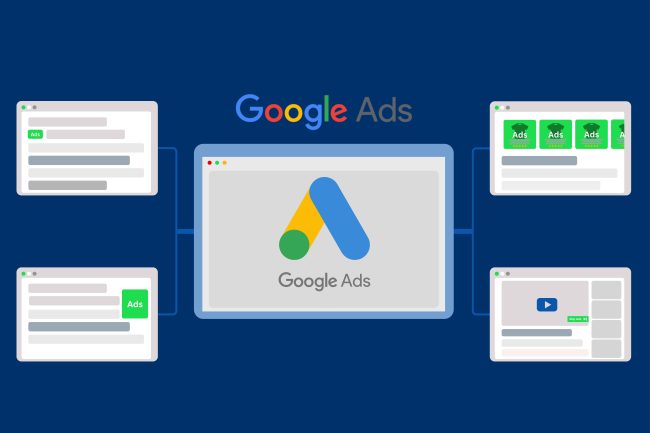
There are several types of campaigns in Google Ads, each used for a different purpose best:
- Search Campaigns: Text ads on the Google search results page. Ideal for addressing intent today and generating leads or sales. Most frequently where to start with new shoppers.
- Display Campaigns: Image and text display ads on Google Display Network (tens of hundred of millions of websites, apps, and YouTube). Ideal for awareness, retargeting, and reach.
- Shopping Campaigns: Product ads with product image, price, and store name on Google Search and Shopping tab. Suitable for e-commerce business.
- Video Campaigns: Pre-roll, display, and video-on-demand on YouTube and video partner sites. Suitable for attention-catching story-telling, brand consideration, and highly intent audience targeting.
- App Campaigns: Used to download apps and engage with apps on Google Search, Google Play, YouTube, and the Display Network.
- Local Campaigns: Where clients are off-line enterprises visible within Google Maps, Search, and YouTube.
- Performance Max Campaigns: Automated, focused campaign type that utilizes Google AI to find converting shoppers on Google inventory (Search, Display, YouTube, Gmail, Discover). New enterprises irrespective of their experience levels might be requested to start with more-complicated types of campaigns first before they are qualified enough to venture into Performance Max.
- Demand Gen Campaigns: Another more recent campaign (after Video Action Campaigns via) for demand-gen and YouTube, Discover, and Gmail engagement through other creative assets.
A Search Campaign would be the easiest to start with for most newbies since it does have primitive intent targeting and control.
Step 3: Do Keyword Research (The Key to Success)
Keywords are phrases and words that your customers are searching for on Google. Keyword research is Google Ads magic sauce.
- Make use of Google Keyword Planner: The free resource (in your Google Ads account, in “Tools and Settings”) can assist you in discovering new keywords, view volume, estimated competition, and obtain estimated estimate bid ranges.
- Identify Purpose: Commercial purpose keywords (e.g., “[buy [product]]”, “[service] near me”, “best [product] reviews”). Informational keywords (e.g., “how to do [something]”) are well-distributed for content marketing.
- Long-Tail Keywords: More precise, longer phrase keywords (e.g., “organic dog food for puppies with allergies”). Less competitive with better conversion rate but worse search volume.
- Negative Keywords: The terms that you don’t want to appear in your ad when a person is searching for (e.g., new car sale, with negative keyword “used” so your ads won’t be displayed when a person is searching for used cars).
- Competitor Keywords: If it’s in your strategy (be careful of trademark law), bid on competitor company name keywords.
Target the short-tail and long-tail keywords. Google recommends 20-30 per ad group as ideal.
Step 4: Organize Your Campaigns and Ad Groups
Well-organized accounts are the ticket to the success of your ads.
 Campaigns: Organize campaigns around your general ad targets or product categories (e.g., “Summer Collection Sales,” “Local Service Leads”).
- Ad Groups: Place your ad groups in a campaign with tightly grouped keywords and ad copy. Ad groups must be very thought-specific. In “Summer Collection Sales” campaign, your ad groups can be “Women’s Swimsuits,” “Men’s Beachwear,” and “Kids’ Sandals.”
- Keywords and Ads: Place your research keywords and similarly related ad copy in their respective ad groups.
Step 5: Write Effective Ad Copy
Your ad copy is your Google front door. You’ll want to make it informative, interesting, and compelling.
- Responsive Search Ads (RSAs): One of the native ad formats of Search campaigns on Google. You can upload up to 15 headlines (30 characters) and 4 descriptions (90 characters). Google algorithm rewrites and optimizes these assets into high-performing combinations for the majority of search queries.
- Use Keywords: Restore your focus keywords to their original position within your titles and descriptions to achieve highest relevancy and Quality Score.
- Identify Unique Selling Propositions (USPs): What’s your USP? (e.g., “Free Shipping,” “24/7 Support,” “Award-Winning Service”).
- Write Good Call to Action (CTA): Get users to do what you want them to do next (e.g., “Shop Now,” “Get a Free Quote,” “Learn More”).
- Use Ad Assets (formerly Extensions): They add additional links and data to your ads by making them larger and more detailed. Some of those are:
- Sitelinks: Links to site pages.
- Callouts: Short descriptive text summary benefit or feature.
- Structured Snippets: Official fact lists (e.g., types, services, brands).
- Call Assets: Enabling customers to call your business directly from the advert.
- Location Assets: Shows your business location and a link to click and view a map.
- Image Assets: Shows your relevant images and your ad search.
Step 6: Budget and Bidding Strategy
- Daily Budget: You set a daily budget by campaign. Google will attempt to spend what you’ve allocated but might spend a little more one day and a little less the next day to average it out over a month.
- Bidding Strategies: Google bids on your behalf in this case.
- Manual CPC: You yourself set your own max bid per keyword. Gives full control but is time-consuming.
- Automated Bidding (Smart Bidding): Google employs machine learning-based strategy which gets real-time optimization to achieve desired objectives. They are getting really smart in the year 2025. Most of the strategies recommended are:
- Maximize Clicks: It is attempting to purchase maximum clicks as budget. Suitable for traffic generation or brand creation.
- Maximize Conversions: It attempts to purchase maximum conversions as budget.
- Target CPA (Cost-per-Acquisition): Attempting to purchase as much conversion as possible at your desired avg. cost per acquisition.
- Target ROAS (Return on Ad Spend): Attempting to squeeze as much value out of your conversions as possible with the hope that you can get your ad spend back. They perform best on most e-commerce.
- ECPC (Enhanced CPC): Perplexing selection where you’re bidding against yourself, and Google are increasing or decreasing them attempting to have you make additional conversions.
For your customers, Target CPA or Maximize Conversions are good defaults after you have conversion tracking. For everything you need is direct traffic, use Maximize Clicks.
Step 7: Select Your Targeting Options
Location Targeting: Target your desired countries, regions, cities, or even business districts.
Language Targeting: Target your users according to Google’s interface language.
Audience Targeting: Display ads to a particular audience based on demographics, interests, behavior, or history of interaction with your business (remarketing).
Ad Scheduling: Select particular days and time when your advertisements are displayed.
Step 8: Set up Conversion Tracking
Not even worth the mention. Conversion tracking informs Google Ads that there’s some useful action (an “action” or “conversion”) taking place on your site (a sale, a lead form fill, a call, etc.). You’re flying blind and just can’t best measure campaign performance and optimize for business results without conversion tracking. Google Analytics 4 (GA4) integration to the rescue.
Step 9: Review and Launch
Proof it all – ad copy, keywords, campaign settings, and budget – before go-live. Look for spelling errors or dead links.
Tracking and Optimizing Your Google Ads Campaigns in 2025
Your go-live is just the start. Ongoing tracking and optimizing ensures maximum ROI.
Key Performance Indicators to Track:
- Impressions: How often the ad is showing.
- Clicks: How often the ad is being clicked.
- Click-Through Rate (CTR): Clicks / Impressions. The better engaging, the more relevant ad will have better CTR.
- Cost-per-Click (CPC): Avg cost per click.
- Conversions: Behavior related to an ad click.
- Conversion Rate (CVR): Conversions / Clicks.
- Cost-per-Acquisition (CPA): Total spent / Number of conversions.
- Return on Ad Spend (ROAS): (Conversion Value / Ad Spend) * 100%. Most critical e-commerce metric.
- Quality Score: Don’t move where it is now for your keywords; raising it will lower your ad position and CPC.
Optimization Strategies for 2025:
- Long-term Keyword Performance Monitoring:
- New keywords to add: Discover new relevant keywords with the help of search query reports.
- Pausing low-performing keywords: Low CTR or high CPA.
- Adding negative keywords: Always have a small negative keyword set to prevent wasteful spend on unwanted search.
- Ad Copy A/B Testing: Test different headlines, descriptions, and calls-to-action to determine what works well with your users.
- Landing Page Optimization: Make land pages fast, mobile, ad-relevant, and concise in describing the conversion process under suspicion.
- Change Bids: Bid up for high-performing keywords and bid down for low-performing keywords. Use Smart Bidding strategies after getting some momentum in conversion.
- Refine Targeting: Experiment with every level of location, audience, and demographic targeting available to reach highest-value segments.
- Follow Google’s Suggestions: Google Ads will provide recommendations on how to optimize your account. Some are crap, but some are stimulating.
- Know Your Competition: Look at what competition is bidding with ad copy and approach and use it to help inform opportunity and gain a competitive advantage.
- Leverage AI Potential: Google’s 2025 AI-fueled ad creative, ad optimization, and reporting capabilities are even more sophisticated. Learn how capabilities like auto-extension and AI creative optimization can power your campaigns.
- Use First-Party Data First: With privacy increasingly becoming a top concern, collecting and responding to your own users’ data (first-party data) will be the priority for targeting and personalization.
What is Google Ads? 2025: What’s New and What’s Trending
The online advertisement keeps evolving dynamically day in and day out, and Google Ads are at the forefront of innovations, particularly in the post-AI era.
- AI Overviews and AI Mode: Advertisers need to ensure that the ads are engaging and informative on Google’s AI Overviews and AI Mode of search results.
- Performance Max Evolution: Performance Max ads will continue to be among the most performing drivers, increasingly intelligent and wiser at driving conversions anywhere in Google. The trap is discovering how to give the appropriate inputs to Google AI (clean conversion objectives, quality creatives).
- Demand Gen Campaigns: Video Action Campaigns to Demand Gen will result in more of engaging the user when he himself is searching for something on YouTube, Discover, and Gmail. Diversification of creative assets will be the focus area of such campaigns.
- Greater Creative Autonomy: Google machine learning is becoming more and more used to pretend to own greater ownership of ad copy, headlines, even image and video as it maintains creatives easy for marketers.
- Privacy-First Advertising: As mounting privacy regulation advances on the horizon down the line, Google will ever more focus on more privacy-compliant solutions. Advertisers will need to get their head around first-party data and being in good standing.
- Measurement and Attribution Innovation: Look for more cross-device tracking capability and insights into device-based customer journey behavior to improve ad performance understanding.
Final Words:
Google Ads 2025 is not an auction keyword market but a miracle environment, if achieved, that has the ability to catapult your business to unprecedented heights of success. Your journey begins waiting at the level of the radically simple nature of the auction, simplifying your objective very well, and beating the keyword research mercilessly.
As you roll out your freshly minted campaigns, never forget that test-first, consistency of exposure, and a dedication to ongoing optimization are your best bets. Let Google machine learning fight the clever human suppression of its overindulgence, and you’ll be an adoring mastermind of advertising success on the high-stimulation web of 2025. Test big, test outside of your metrics, and move outward as you generate returns. The legend of advertising expansion through Google Ads is a myth.
If you want to get Google Ads Services, you can contact me.
 |
||||
Md Sazib Hossain
|
 |
M: +8801778829304 M: +8801611911713 Email: sazib.1idea@gmail.com web: 1idea.com.bd/ 1iDEA DIGITAL, Navana D.H. Tower, 6 Panthapath, Dhaka 1215, Zip Code, Country |
||


