
SEO vs Facebook Campaigns: Which One Should You Invest In?
For business owners, marketing directors, and digital strategists, the question of budget allocation is a constant battleground. You have a finite amount of capital to deploy, and you need a predictable, scalable return on investment (ROI). As you audit your growth channels, two titans inevitably emerge to claim the lion’s share of your budget: Search Engine Optimization (SEO) and Paid Facebook Campaigns.
It is common to hear agency pitches claiming that one completely invalidates the other. An SEO specialist will tell you that paid ads are an expensive addiction, while a media buyer will argue that organic search takes far too long to move the needle.
The truth is far more nuanced. When analyzing SEO vs Facebook, you are not just comparing two different platforms; you are comparing two entirely fundamentally opposed marketing philosophies: Inbound Intent-Driven Marketing vs. Outbound Discovery-Driven Marketing.
Deconstructing the Contenders: Definitions and Mechanics | SEO vs Facebook
To understand where your capital belongs, we must first establish exactly how these channels function and generate revenue.
Search Engine Optimization (SEO)
SEO is the strategic process of optimizing your digital assets—including your website structure, page speeds, and long-form content—to rank at the top of organic search engine results pages (SERPs) for targeted keywords.
SEO is an inbound “pull” marketing strategy. It relies entirely on pre-existing user intent. The user realizes they have a problem, navigates to a search engine, types a query, and encounters your brand as the definitive answer to their problem.
Facebook Ads (Paid Social)
Facebook Campaigns operate on Meta’s advanced advertising network, allowing you to pay to display targeted image, video, or carousel ads directly inside a user’s Facebook feed, Instagram Reels, Messenger inbox, and audience network.
Facebook is an outbound “push” marketing strategy. It relies on discovery and disruption. The user is not actively looking to buy a product or hire a service; they are on the platform to consume media, connect with friends, or be entertained. Your advertisement must interrupt their passive browsing experience and instantly manufacture a desire that didn’t exist a moment prior.
Core Differences: The Strategic Showdown | SEO vs Facebook
The fundamental difference between SEO vs Facebook dictating your business growth lies within three structural pillars: intent, velocity, and asset lifetime value.
A. Consumer Intent vs. Audience Demographics | SEO vs Facebook
- SEO is intent-based: When someone searches for “best enterprise accounting software” or “emergency plumber near me,” their intent is maxed out. They are deep in the consideration or decision phase of the buying funnel. They don’t need to be convinced that they need the service; they just need to be convinced that your company is the right choice.
- Facebook is Profile-Based: Facebook doesn’t know what a user is thinking right now, but it knows everything about who they are. It knows their age, geographic location, relationship status, household income bracket, and interests. If you sell a luxury product for dog owners, Facebook can display your ad to people who match that exact demographic profile—even if they aren’t thinking about buying a dog leash at that precise second.
B. Velocity of Results (Speed to Market) | SEO vs Facebook
- The Facebook Sprint: Facebook campaigns offer near-instant gratification. Once your ad creative is uploaded, your targeting parameters are set and your billing info is approved, your campaign goes live. Within hours, you can drive targeted traffic to your landing page and generate sales. If you have an inventory clearance sale or a time-sensitive event, Facebook is a sprint channel.
- The SEO Marathon: Organic growth is notoriously slow. It takes time for search engine spiders to crawl your content, assess its domain authority, evaluate user signals, and organically push you to page one. A brand-new website launching a modern content marketing campaign might not see meaningful organic traffic for 3 to 6 months. It is an iterative, compounding marathon.
C. The Cost Structure and Continuity | SEO vs Facebook
- Facebook’s Pay-to-Play Model: Paid social operates like a faucet. Turn the money on, and the traffic flows instantly. Turn the money off, and your traffic drops to zero overnight. You are renting attention from Meta. Over time, as ad space becomes more competitive, your Cost-Per-Click (CPC) and Cost-Per-Mille (CPM—cost per thousand impressions) naturally trend upward, forcing you to continuously increase ad spend to maintain the same volume of leads.
- SEO’s Compounding ROI: Organic search operates like real estate equity. You pay upfront for the construction of high-quality assets (such as hiring writers for comprehensive SEO content, improving technical site speed, and earning high-authority backlinks). However, once those assets rank on page one, they drive continuous, targeted traffic day and night without an associated cost-per-click. The upfront cost transforms into long-term organic equity.
Financial Analysis: Upfront Costs vs. Long-Term Value: SEO vs Facebook
To truly understand which framework deserves your budget, we must evaluate the unit economics and compounding return on investment over an extended timeline.
Let’s look at a financial projection modeling a $2,000 monthly marketing spend across a 12-month period for a typical mid-sized B2B service provider or e-commerce store.
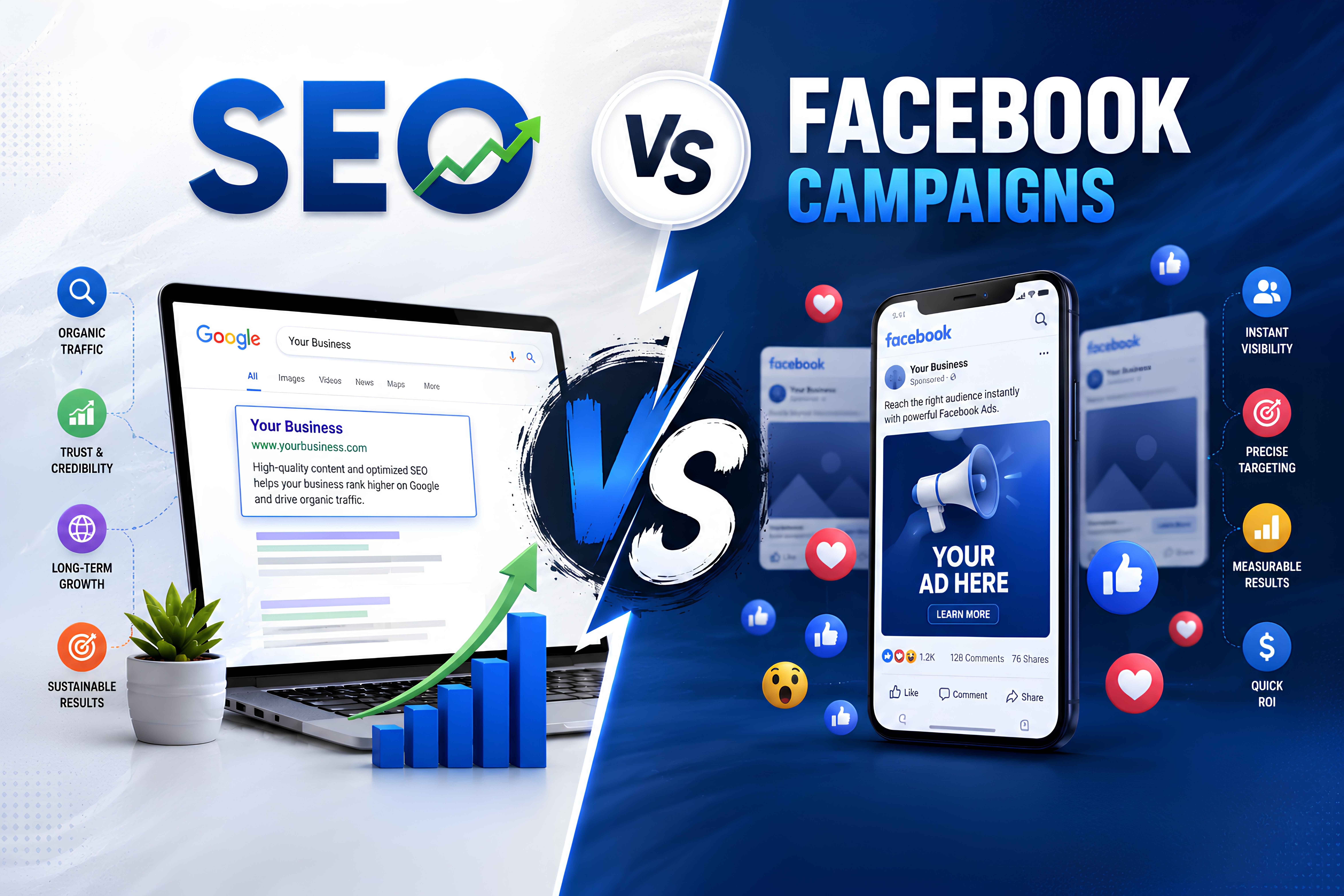
SEO vs Facebook Campaigns
Scenario A: Investing $2,000/Month into Facebook Ads
With paid social, your acquisition cost scales linearly with your ad spend, subject to ad fatigue and market bidding fluctuations.
- Months 1–3: You spend $6,000. Meta’s pixel optimizes rapidly. You generate an immediate stream of leads/conversions. Let’s assume an acquisition cost of $40 per conversion, yielding 150 conversions.
- Months 4–6: You spend another $6,000. Creative fatigue sets in; users get tired of seeing the same banners. Your acquisition cost rises slightly to $45. You bring in 133 conversions.
- Months 7–12: You spend $12,000. Competitors duplicate your ad angles, increasing auction bidding costs. Your acquisition cost stabilizes at $50, netting 240 conversions.
- Total Year 1 Metrics: Total spend: $24,000. Total conversions: 523. Average Cost Per Conversion: $45.88.
- Day 366 Catch: If you halt your budget on Day 366, your traffic and conversions hit absolute zero instantly.
Scenario B: Investing $2,000/Month into Organic SEO
With organic search optimization, your financial input goes into building content infrastructure and technical authority, meaning conversions are low initially but compound exponentially over time.
- Months 1–3: You spend $6,000 on technical audits, keyword mapping, and publishing high-value long-form articles. Your site is indexed but sits on pages 3 and 4 of Google. You generate 10 conversions. Cost per conversion: $600.
- Months 4–6: You spend another $6,000. Your older content gains authority and moves to the bottom of page one. Organic traffic builds. You land 60 conversions. Cost per conversion drops to $100.
- Months 7–12: You spend $12,000. Your content begins ranking for hundreds of long-tail semantic variations. You capture high-intent informational queries. You generate 600 conversions during this window. Cost per conversion drops to $20.
- Total Year 1 Metrics: Total spend: $24,000. Total conversions: 670. Average Cost Per Conversion: $35.82.
- Day 366 Catch: If you halt your budget on Day 366, your optimized content assets continue to sit at the top of Google search results. You will likely continue to receive hundreds of free conversions for the next 6 to 12 months without spending another dollar.
Head-to-Head Comparison Table: SEO vs Facebook
To give you clarity at a glance, this table breaks down the technical and operational differences between SEO vs Facebook campaigns across key business metrics.
| Performance Metric | Search Engine Optimization (SEO) | Facebook Advertising Campaigns |
| Primary Traffic Driver | User Intent (Active Problem Solving) | Disruption & Discovery (Demographics/Interests) |
| Speed to Initial Conversion | Slow (Typically 3 to 6 months) | Extremely Fast (Within 24 to 48 hours) |
| Long-Term Cost Efficiency | Exceptionally High (Costs decrease over time) | Linear/Rising (Tied directly to ongoing ad spend) |
| Asset Ownership | You own the digital assets and web traffic channels | You rent impressions inside Meta’s closed sandbox |
| Audience Mindset | High-intent purchasing or research mode | Casual, social browsing, entertainment mode |
| Maintenance Required | Content refreshes and continuous technical health | Constant creative updates to prevent ad fatigue |
| Primary Algorithm Factor | E-E-A-T, backlink profiles, user experience | Ad CTR, engagement metrics, past conversion data |
When to Choose SEO: The Ideal Business Scenarios | SEO vs Facebook
SEO is not a universal band-aid, but for specific business models and consumer offerings, it is the absolute foundation of corporate survival.
High-Search Volume Industries
If your data shows that tens of thousands of people are typing your exact product or service name into Google every month, you are leaving free money on the table by ignoring organic visibility. Failing to rank means you are willingly handing market share directly to your organic competitors.
Urgent, Problem-Solving Services
If a consumer’s basement floods at 2:00 AM, they do not open Facebook, scroll past memes, and hope to stumble upon an ad for a restoration company. They open Google and type “emergency water extraction near me.” Emergency services, medical professionals, legal counsel, and repair businesses must prioritize search over social.
High-Ticket B2B & Software-as-a-Service (SaaS)
Enterprise software and expensive professional services have long, complex sales cycles. Before a corporate executive signs a $10,000 monthly retainer contract, they perform months of exhaustive digital research. They read case studies, look over whitepapers, and review comparison blogs. If your brand dominates the educational search results during their research journey, you become the default choice when they are ready to sign.
When to Choose Facebook: The Ideal Business Scenarios | SEO vs Facebook
Conversely, there are marketing environments where relying entirely on organic search will choke your cash flow. Facebook is an absolute weapon when applied to the right business parameters.
Low or Non-Existent Search Volume (Novel Products)
If you have invented a completely revolutionary gadget—for example, a specialized ergonomic neck hammock that cures jet lag—nobody is searching for it because nobody knows it exists. You cannot optimize content for a keyword that has zero monthly search volume. You must use the visual power of Facebook and Instagram video ads to show the product in action, articulate the problem, and actively build a new market from scratch.
Impulse-Buy E-commerce & Direct-to-Consumer (D2C) Brands
If you are selling fashion apparel, trendy lifestyle accessories, or affordable home decor products priced under $75, your conversion path is short. These are visual, emotion-driven purchases. A stunning, high-contrast video ad showing someone wearing your product can trigger an immediate impulse purchase within a single session.
Local Event Promotion and Short-Term Offers
If you are hosting a regional business conference next month, running an entry-level gym membership special for the next 14 days, or hosting a restaurant grand opening, you do not have the luxury of waiting 90 days for an article to rank on Google. You need targeted local eyeballs immediately, making Facebook’s hyper-local geographic targeting parameters the perfect fit.
The Dangerous Pitfalls of Both Mediums: SEO vs Facebook
To run a truly efficient digital marketing department, you must look past the glowing case studies and understand the systemic vulnerabilities inherent to both channels.
The Vulnerabilities of Organic SEO
- The Core Algorithm Shock: Google updates its algorithm frequently to prioritize helpful, user-centric content. If your strategy relies on low-quality AI text generation, mass backlink farms, or keyword stuffing, an algorithm shift can cut your organic traffic in half overnight.
- Highly Delayed Feedback Loops: Because changes take weeks to reflect in search rankings, identifying a failure in your keyword targeting or technical architecture takes months, leading to prolonged periods of zero conversion attribution.
The Vulnerabilities of Facebook Campaigns
- Ad Fatigue and Creative Burndown: The lifespan of a Facebook ad is incredibly short. An ad angle that crushes your target metrics in Week 1 will often decay by Week 4 as your target demographic sees it repeatedly, causing click-through rates to tank and conversion costs to spike. You must run a relentless creative production line to constantly replace underperforming banners and videos.
- Data Privacy and Tracking Degradation: Privacy regulations and operating system updates (such as iOS data privacy changes) have made it harder for the Meta pixel to track off-platform conversions accurately. This data degradation forces the algorithm to work harder to optimize your ad spend, occasionally resulting in unstable, erratic lead costs.
Strategic Integration: The Hybrid “Omnichannel” Blueprint | SEO vs Facebook
The discussion shouldn’t actually be about SEO vs Facebook in a vacuum. The most successful modern corporations don’t pick one—they unify both into a synchronized, self-reinforcing customer acquisition ecosystem.
Here is how you can merge both channels to maximize profitability:
Step 1: Use Facebook Ads for Rapid Audience and Messaging Validation
Before investing thousands of dollars into a 6-month long-form content marketing campaign, test your concepts on Facebook. Run inexpensive ad variations testing different value propositions, headlines, and pain points. Analyze which hooks receive the highest engagement and click-through rates. Once your Facebook data proves which angle resonates most with your audience, hand that exact data to your content team to structure your permanent SEO strategy.
Step 2: Capture Search Traffic via Technical SEO
Execute your organic playbook. Publish deep, comprehensive articles that answer high-intent informational and transactional queries. Capture the traffic of users who are searching for solutions within your niche.
Step 3: Implement Retargeting via Facebook
Not everyone who lands on your website from an organic Google search will buy from you on their first visit. In fact, industry data shows that roughly 95% to 98% of cold organic traffic leaves a website without converting.
Instead of letting those high-intent users vanish forever, install the meta pixel on your site. When an organic visitor reads your optimized blog post but exits without purchasing, trigger a customized retargeting campaign on Facebook. Show them a client testimonial video or a specific case study ad as they scroll their social feed.
The Retargeting Multiplier: By using Facebook to retarget your warm organic traffic, you convert cold search visitors at a drastically lower ad spend than targeting completely cold social profiles.
Decision Framework: Where Should You Allocate Your Budget Today?
If you are looking at your balance sheet right now and need to make an immediate budgetary allocation, use this explicit checklist to make your decision.
Choose Facebook Advertising Campaigns If | SEO vs Facebook
- Your runway is short: You need to generate revenue or secure leads within the next 30 days to sustain your business operations.
- Your offering is visual or emotional: Your product looks incredible in video format and relies on impulse-buy psychology.
- You are starting with no organic footprint: You have a brand-new domain name and cannot afford to wait months for search engine indexing to take hold.
Choose Search Engine Optimization (SEO) If: SEO vs Facebook
- You want to build long-term business equity: You want to lower your average customer acquisition cost over the next 12 to 24 months.
- Your product answers an explicit, active problem: There is verified, pre-existing search volume for your industry, and users are actively looking for an alternative to your competitors.
- You operate in a high-ticket or trust-based vertical: Your sales cycle requires your brand to demonstrate massive educational authority, trust, and deep expertise before an exchange of capital occurs.
Final Thoughts
In the debate of SEO vs Facebook, there is no singular victorious channel—there is only the right tool for your current stage of business growth.
Facebook is your digital accelerator pedal; it provides instant velocity, rapid market feedback, and immediate scale at a linear, predictable cost. SEO is your digital real estate investment; it demands significant upfront labor and patience, but it rewards you with an insulated, compounding traffic engine that builds enterprise value and drives down acquisition costs over time.
Assess your cash flow timeline, analyze the intent profile of your ideal buyer, and deploy your capital not into the channel that sounds the flashiest but into the one whose underlying mechanics match your immediate operational goals.